
Facial Recognition Software Is Only The Newest Layer Of Attempts At Pacification
HIDTA, Surveillance, and the Quiet Architecture of Control

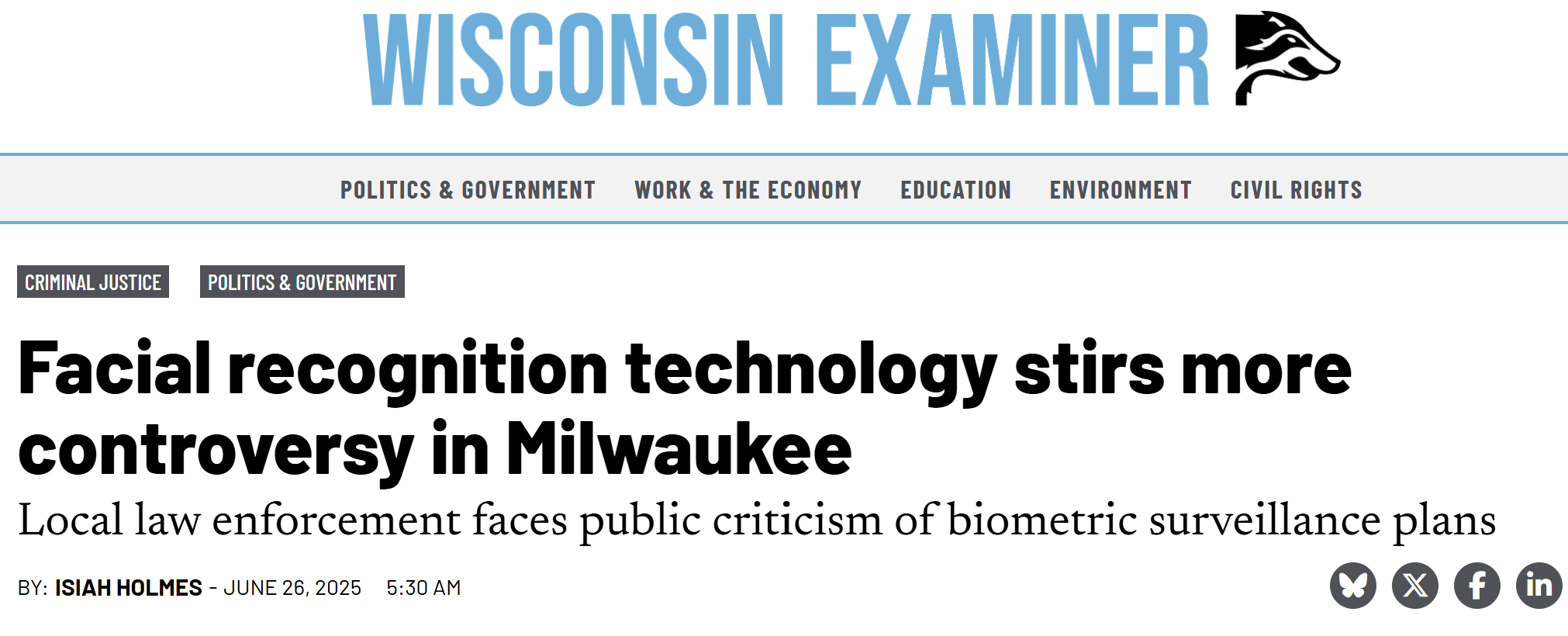
In recent weeks, Milwaukee’s decision to halt the implementation of facial recognition software has been treated as a discrete policy victory, an isolated debate about a single technology. But facial recognition does not exist in a vacuum. It is simply the most visible and most recent expression of a much older system of intelligence gathering and information sharing that has been quietly expanding for decades through multijurisdictional law-enforcement partnerships. Long before cameras were trained on faces, data was already being collected, shared, and analyzed across municipal, county, state, and federal agencies under the guise of public safety. Facial recognition is not the beginning of this story; it is the next logical step in a surveillance architecture that programs like HIDTA helped normalize; an architecture built on crisis, expediency, and the steady erosion of local consent.
Shortly after my sister passed away in 2020, I found myself compulsively reading policy, local, state, and federal. At first, it was COVID-19: emergency powers, institutional mandates, and how quickly ordinary life could be reorganized through executive authority in the name of crisis. Then George Floyd was murdered only miles from where I spent much of my childhood. Protest followed grief, and grief sharpened my attention. On my way home from demonstrations, scrolling through my NewsBreak app, I saw a headline that would change the trajectory of my advocacy: the U.S. Attorney for the Western District of Wisconsin was pursuing a High Intensity Drug Trafficking Area (HIDTA) designation for Eau Claire County.
That headline sent me down a rabbit hole.

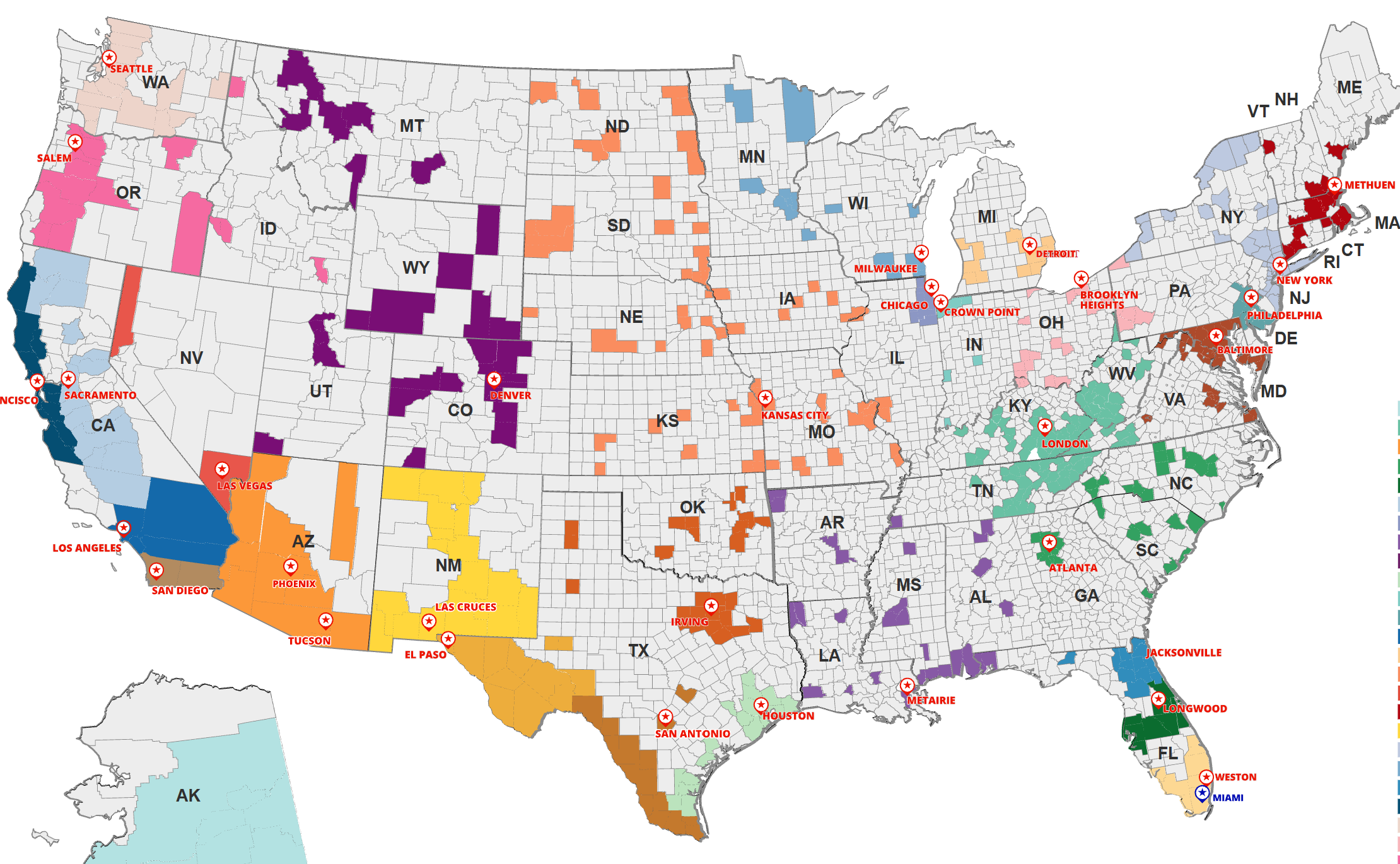
HIDTA is not a local program. It is a federally administered, multijurisdictional drug task force designation operating under the Office of National Drug Control Policy, with funding and operational support flowing through the Department of Justice. Once designated, HIDTA regions integrate municipal, county, state, and federal law-enforcement agencies into a single intelligence and enforcement ecosystem. They share resources, funding, personnel, and most importantly, information. HIDTA is explicitly framed as part of the “war on drugs,” and that framing is not accidental. It is a direct descendant of the enforcement philosophy that dominated the 1980s and 1990s, when surveillance, preemption, and incapacitation replaced community-based solutions.
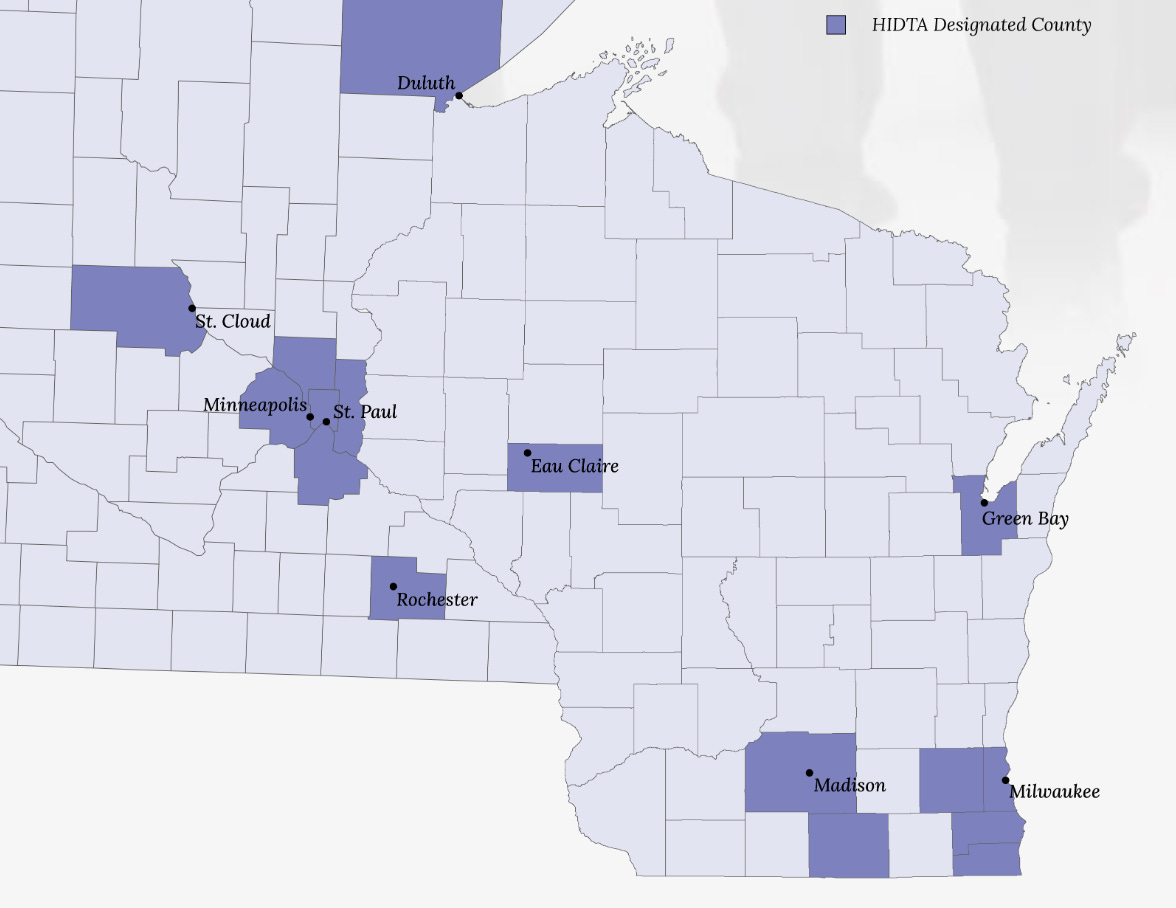
In Wisconsin, HIDTA designations follow a predictable pattern. They appear in counties that sit astride major transportation corridors or industrial hubs: Milwaukee County, Racine County, Kenosha County, Rock County, Dane County, Brown County, and Eau Claire County. Look at a map and the logic becomes obvious. Interstate 94 cuts through Eau Claire, Dane, and Milwaukee. Interstate 90 runs through Dane and Rock Counties into Illinois. Highway 29 crosses Brown County toward northeastern Wisconsin. These corridors connect Minnesota to Illinois, and from Hennepin and Ramsey Counties all the way down to Cook County, Illinois, the Midwest’s major thoroughfares are effectively locked down by overlapping, multijurisdictional drug task forces.
But infrastructure alone does not tell the whole story.
In Wisconsin, more than 80% of the state’s African-American population lives in HIDTA-designated counties, despite those counties representing a small fraction of the state’s 72 counties. Large numbers of Brown and poor white residents also live within these same jurisdictions. This is not coincidence. It is the downstream effect of redlining, industrial zoning, and decades of housing policy that concentrated marginalized populations in the least desirable areas of cities, i.e., areas that also happen to sit along ports, rail lines, and highways.
HIDTA overlays hyper-surveillance onto those same spaces.
In 2020, the Sheriff of Eau Claire County publicly minimized the designation, stating that only a nominal amount of funding would come with HIDTA and that it would not significantly alter law-enforcement operations. I have heard this justification many times. It misses the point. The true value of HIDTA is not money. It is information.
When someone is arrested in a drug investigation, their phone is often dumped; contacts, messages, metadata, location history. Hundreds or thousands of data points are extracted. Most of those communications have nothing to do with drugs. They are parents coordinating carpools, coworkers texting schedules, neighbors checking in, friends sharing family updates. But all of it becomes data. With enough arrests, law enforcement can map entire communities, social networks, routines, associations, without ever needing to knock on most doors.
Those data points do not stay local. HIDTA exists precisely to share intelligence upward and outward.
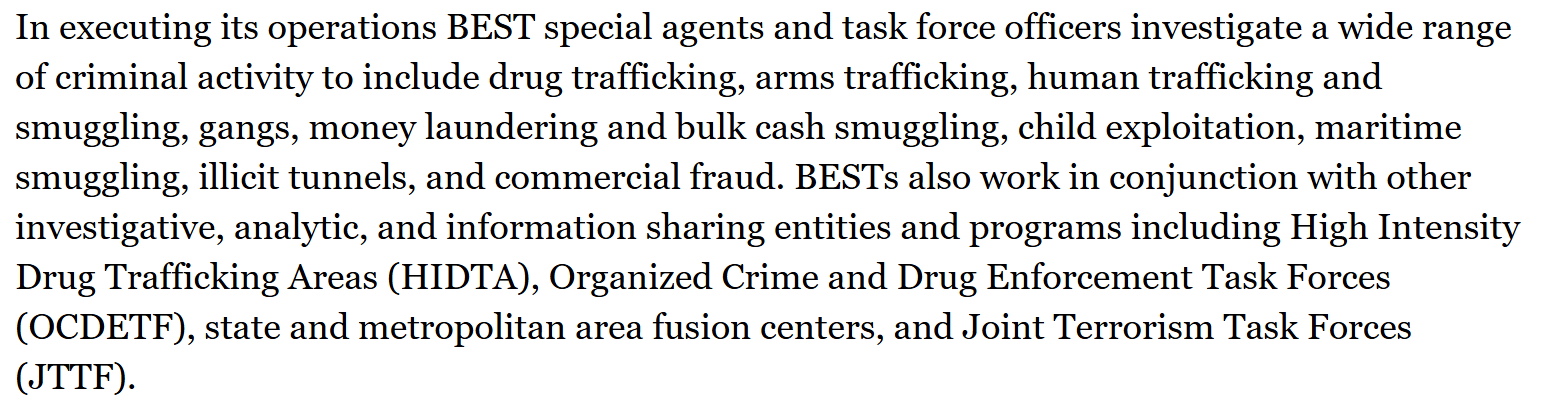
This is where the connection to federal enforcement becomes unavoidable. On the Department of Homeland Security’s own materials, Border Enforcement Security Task Forces (BEST) are described as collaborating with HIDTA regions. ICE and Border Patrol do not operate in an informational vacuum. They rely on the same intelligence streams generated through drug enforcement, gang databases, and multijurisdictional task forces. When federal agents deploy into neighborhoods with confidence, it is because the groundwork has already been laid through years of data collection.
This is not speculation. It is how modern enforcement works.
I saw it firsthand long before I understood it intellectually.
In 2012, while incarcerated in the Waukesha County Jail, I watched federal indictments roll in from Milwaukee. One case involved what was known as “EZ Money,” or the “East Side Drug Ring.” The individuals were brought in at night, in coordinated operations, separated from one another, and moved through the system with precision. Over time, as I cycled through different security levels due to having been sent to solitary confinement, I met several of them. The story was always the same: they were “snatched” in similar ways, under similar conditions, transported out of their neighborhoods without warning. Years later, my colleague Sean Wilson would describe the same phenomenon; people from his neighborhood simply disappearing, only to be found later in prison.
What struck me later was how familiar this felt.
As an infantry soldier in Iraq, I participated in high-value target operations. Before a raid ever occurred, the neighborhood had already been mapped. Intelligence had identified who lived where, which vehicles were present, who associated with whom. Units established outer and inner cordons. Assault teams moved in. Quick Reaction Forces stood by. Biometrics were collected. Vehicles were logged. Aerial surveillance tracked movement. The operation followed a doctrine: search, silence, segregate, secure, and speed to the rear, i.e., the 5 S’s of Detainee Operations.
When I watched federal law-enforcement operations unfold back home, I realized I was seeing the same logic applied domestically. The difference was not the method, but rather, the justification.
This is what pacification looks like in a modern liberal democracy. It is not tanks in the streets at first. It is databases. It is intelligence fusion. It is task forces justified by expediency. And it is always sold as public safety.
This brings us back to Milwaukee.
The recent decision by Milwaukee to halt the implementation of facial recognition software is a meaningful victory. It represents a rare moment where a community collectively said no to another layer of surveillance. But facial recognition is not the disease. It is a symptom. It is the next evolution of the same intelligence logic that HIDTA normalized decades ago.
Facial recognition would have fed on the same data streams: booking photos, arrest records, public-records databases, and images captured through unrelated investigations. Once integrated, it would not have mattered whether a person was suspected of a crime. Association alone is enough. Your face appears in someone else’s phone. Your image shows up near an investigation. Your data enters a system you never consented to join.
Milwaukee did the right thing by stopping the most recent assault on privacy. But stopping one tool without confronting the architecture beneath it is not enough.
HIDTA remains. Intelligence sharing remains. Federal-state task force integration remains. And as long as those structures exist, new tools will continue to appear.
This is not a partisan issue. Both Republicans and Democrats have enabled this expansion. Both have traded liberty for expediency. And too often, it is not some distant bureaucrat who signs off on these programs—it is your neighbor who works in a government office, your local official who accepts the funding, your council member who votes yes because the consequences feel abstract.
But the consequences are not abstract. They are real. And they are cumulative.
To pacify a population, you do not need mass arrests all at once. You deny access to justice. You strip their religious institutions. You collect intelligence on every area of their lives. And eventually, you conduct military-style operations on city streets while insisting nothing has fundamentally changed.
That is not freedom.
If Milwaukee is serious about protecting its people, it must go beyond rejecting facial recognition. It must question every information-sharing agreement, every task force, every designation that trades community autonomy for enforcement efficiency. The same applies to every HIDTA county in Wisconsin.


This is not about opposing law enforcement. It is about reclaiming consent. If someone is harming our community, we can collectively authorize intervention. What we must reject is the quiet sale of our collective data into systems that operate far beyond our control.
Once our information is gone, it does not come back. And once the intelligence is built, the operation is already planned.
Now is the moment to stop living on our heels. The fight is not against one technology or one agency. It is against an entire way of governing that confuses surveillance with safety and control with care.
If any of this sounds familiar, it could be because you’re experiencing the surveillance state being built right under your nose. And if we do not confront it now, it will continue, quietly, efficiently, and without our consent.
That is the architecture of pacification. And dismantling it begins locally, or not at all.